On Monday, 9 February, I am scrolling through Instagram. Writing tips. Book recommendations. Home interiors. The algorithm doing what it does best, keeping life curated and comfortable.
Then I see it.
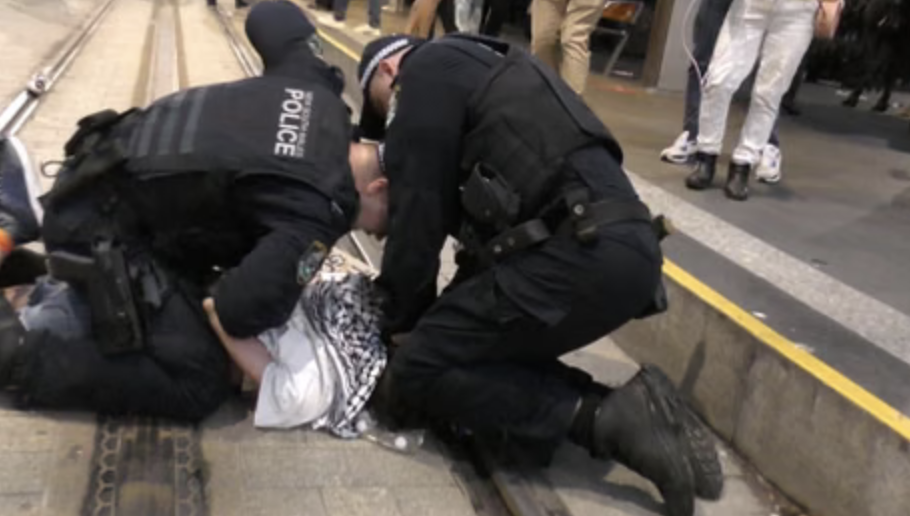
A policeman strides toward a civilian pinned to the ground. Punches land. Another officer joins. Then another. The blows keep coming.
For a moment, I assume the footage is from overseas. A sharp déjà vu takes hold, an echo of a young man kicked in the head in the UK while his mother watched, of a man dying with a knee pressed into his neck in Minneapolis. Surely this is from somewhere we have grown accustomed to seeing such things.
But it is not. It is Sydney. It is from the protest over the arrival of the Israeli President, Isaac Herzog.
The shock lands differently when it is home.
When the federal election results came in, much of the country exhaled. We had voted to prevent a Trumpian turn. We reassured ourselves that Australia does not harbour extreme politics, that ours is a multicultural society held together by tolerance, diversity and social cohesion. Our institutions, we told ourselves, are steady. We are not like that.
The footage from 9 February shattered that reassurance. Not because it showed police aggression; that, sadly, is not new. But because of the truth it forced to the surface: authoritarian impulses do not require a far-right banner. They do not need a particular party in power. They do not wait for a strongman. They require only institutions willing to act without restraint, and narratives willing to frame that restraint as necessary. This can happen under any government. It just did, under ours.
Racism, Islamophobia and reactive hostility did not suddenly surface in those punches. They have been embedded in our political culture, sometimes subtly, sometimes thinly veiled, always waiting for activation. What we witnessed was not an aberration. It was a permission structure finally made visible.
But the violence is only the beginning. What follows it is more dangerous: the normalisation.
Within hours, a familiar machinery was at work. The footage was declared out of context. The protest was labelled a disturbance of peace, a provocation designed to bait police response. This is exactly the justification an aggressor gives: they made me do it. The force was not excessive, we were told. It was necessary. It was proportionate. It was protection.
Protection for whom?
This is the narrative architecture that should alarm us. A peaceful protest is recast as disorder. Uniformed violence is re-framed as crowd control. Restrictions on gatherings and demonstrations tighten, and each time, the language of safety is deployed to make the tightening feel reasonable. It does not arrive as a dramatic crackdown. It arrives as common sense. And that is precisely what makes it effective.
We absorb this framing. It trickles from figures of authority, is amplified by news media and talk shows with enormous reach, and settles into the way we understand what happened. Gradually, what was shocking becomes expected. What was unacceptable becomes debatable. The window shifts, and we barely notice it moving.
I notice it moving in myself.
The images have settled in me. I know that the next time I see a police officer, I will not see only authority. I will see possibility. If I am pulled over for not stopping at the line for exactly three seconds, something will tighten, not because of my mistake, but because of fear. Fear of racial profiling. Fear of a disproportionate response. That reflex does not come from paranoia. It comes from precedent.
I am not alone in this. For those of us who watched the footage and saw ourselves in the body on the ground, something shifted. For some, it confirmed a long-held suspicion that belonging in this country has always been conditional. For others, it produced a new unease, a quiet recalibration of how safe we actually are. And for those who already harboured bias, the footage and the justifications that followed offered something else entirely: validation. Their instincts were no longer fringe. They were institutional.
This is how a society fractures. Not in a single rupture, but in the slow, continuous work of reinforcement. Prejudice solidifies in some. Anxiety deepens in others. And the distance between the two grows wider with every broadcast, every dismissal, every official reassurance that what we saw was not what we saw.
This is the quiet damage.
The most dangerous shift is not the individual punch. It is the normalisation of it. It is the narrative that prepares us to accept it. It is the subtle redefinition of who is fully protected and who is merely tolerated.
Many of us left our birth countries and now call Australia home. We fled autocracy, believing we were moving toward something better. The footage from 9 February did not just show police officers beating a man on the ground. It showed us the distance between the country we believed in and the one we may actually live in.
We say Australia advances. We say our homeland is fair. The question is whether fairness advances with it, or has quietly become selective.